Excellence with Receipts
I’m grateful to have my work recognized by both nonprofit leadership and academia.
These letters of recommendation highlight how I bring together data engineering, analytics, and real-world impact across community work and research. They speak to my ability to design end-to-end data systems, ensure data quality, and collaborate with cross-functional teams to turn complex data into practical decisions.
Letter 1 – Big Brothers Big Sisters of Ventura County
Big Brothers Big Sisters of Ventura County – Youth Center Data Platform
In this letter, Danica Selvaggio, CEO of Big Brothers Big Sisters of Ventura County, describes my role leading the design, development, and management of databases for the Youth Center Hackathon project. I built backend systems to track youth participation and engagement in real time, improved the frontend experience for staff, and created visual and statistical reports that helped leadership make data-driven decisions.
What this letter emphasizes:
-
End-to-end database design for tracking youth participation and engagement
-
Real-time, secure backend data processing to support staff decisions
-
User-friendly interfaces that bridge functionality and accessibility
-
Strong collaboration with cross-functional teams and consistent professionalism
View Recommendation Letter – Big Brothers Big Sisters of Ventura County
Letter 2 – Bear River Health Department
Bear River Health Department – Public Health Data Modernization & KPI Platform
In this letter, Holly Budge (Deputy Health Strategist) and Spencer George (Personnel Support Officer) document my role as a Data Engineer under the CDC Foundation’s Workforce Acceleration Initiative (WAI), where I led the development of a scalable KPI dashboard ecosystem and modern data platform for the Bear River Health Department.
The letter highlights my contributions in designing and implementing a comprehensive analytics system, collaborating with cross-functional public health teams, and delivering a solution that has gained national-level visibility and adoption interest across U.S. health agencies.
What this letter emphasizes:
-
Development of a large-scale KPI dashboard system (34+ webpages, 40+ visualizations) supporting public health decision-making
-
Direct collaboration with multi-program public health teams to define and standardize KPI metrics
-
Implementation of automated data update processes, reducing reliance on manual CSV workflows
-
Focus on accessibility and usability, including ADA-compliant design considerations
-
Integration and exploration of AI-driven approaches to support long-term system sustainability
-
Contribution to national conference presentations and knowledge sharing, demonstrating external recognition
-
Evidence of scalability and replication, with planned adoption across additional rural health departments
View Recommendation Letter – Bear River Health Department
Letter 3 – Code for Good
Code for Good – Letter of Excellence
This Letter of Excellence formally recognizes my outstanding technical innovation and societal contribution at Code for Good. It explains how my scalable, governance-ready data solutions helped Big Brothers Big Sisters and Mesa Farms modernize their digital infrastructure and deliver measurable benefits for communities nationwide.
What this letter emphasizes:
-
Built a fully integrated backend and reporting system for the BBBS Youth Portal, unifying volunteer, donor, and participant data into one analytical view.
-
Automation improved privacy compliance and gave program leaders instant impact metrics, improving services for thousands of youth and mentors.
-
Engineered architecture, pipelines, auth logic, and real-time analytics for the Mesa Farms Community Portal supporting young adults facing homelessness.
-
Systems are replicable, open-source, and designed for sustainable growth, creating a template that other NGOs can adopt affordably.
-
Code for Good ranks me among their most exceptional professionals, explicitly linking my work to social equity, digital accessibility, and data-driven decision-making.
View Code for Good – Letter of Excellence
Letter 4 – University of North Texas (AIM-AHEAD Project)
University of North Texas – AIM-AHEAD Cancer Survival Analytics
This letter from Dr. Suman Niranjan (Assistant Professor, Department of Supply Chain Management) highlights my work leading data management and advanced analytics for the AIM-AHEAD project. I cleaned and integrated large-scale SEER and Medicare datasets, built visualizations, and applied machine learning models to study breast cancer stages and survival outcomes, with a focus on fairness and explainable AI.
What this letter emphasizes :
-
Managing complex health datasets: handling missing values, duplicates, and standardization
-
Integrating SEER cancer registry and Medicare data using Zip and FIPS codes into a unified dataset
-
Using SQL, Tableau, Excel, Matplotlib, and ML (Gradient Boosting, OLS regression) for deep analysis
-
Building predictive models with explainable AI methods to support clinicians and researchers
-
Communicating insights clearly to both technical and non-technical audiences
View Recommendation Letter – University of North Texas (AIM-AHEAD)
Together, these recommendations show that I’m trusted to own critical data systems, improve data quality, and turn analytics into meaningful outcomes—whether it’s for community-based youth programs or large-scale health research.
Letter 5 – Code for Good
Code for Good – Nonprofit Tech & Data Engineering Recommendation
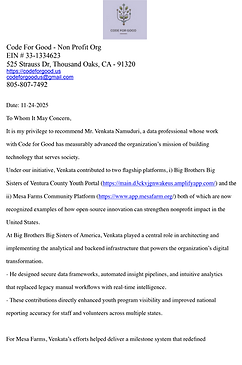
This letter from Saritha Ivaturi, Founder & President of Code for Good, describes how my work on the Big Brothers Big Sisters Youth Portal and the Mesa Farms Community Platform advanced their mission of building technology that serves society. It highlights my role in architecting secure data frameworks, automated insight pipelines, and backend systems that modernized two major U.S. nonprofits.
What this letter emphasizes:
-
I contributed to two flagship platforms: Big Brothers Big Sisters of Ventura County Youth Portal and Mesa Farms Community Platform.
-
Designed secure data frameworks, automated analytics pipelines, and intuitive reporting that replaced manual workflows with real-time intelligence.
-
Helped improve youth program visibility and national reporting accuracy for Big Brothers Big Sisters.
-
Led backend components, database design, and QA for Mesa Farms, bringing a volunteer-built platform up to production-level standards.
-
Ongoing collaboration with Code for Good’s internal research group on agentic AI, showing trust in my AI & data-quality work.


Engineering Technology Where It Creates the Greatest Social Value
Across public health, healthcare research, and community-based nonprofits, my work has focused on a common engineering challenge: making sophisticated data capabilities accessible to organizations whose primary mission is serving communities rather than building technology. I design systems that transform fragmented information into usable intelligence while emphasizing automation, scalability, maintainability, and practical resource constraints.

Community Impact
Big Brothers Big Sisters of Ventura County/Mesa
Building Digital Infrastructure for a Community Nonprofit
Before My Contribution
-
Big Brothers Big Sisters of Ventura County operated a community-focused youth program where staff needed to manage information about youth participation, engagement, and program activities, but lacked a unified digital environment capable of connecting operational data with reporting and decision support.
-
As a nonprofit organization serving communities rather than operating as a technology company, its resources needed to be focused primarily on its mission and the people it served. This created a need for practical technology that could deliver meaningful data capabilities without the complexity and cost of a large enterprise platform.
My Distinctive Technical Contribution
-
I designed and engineered a mission-focused digital data platform that brought together backend data management, database architecture, application functionality, and reporting into an integrated system.
-
Instead of delivering an isolated analytical report, I created an underlying technical foundation that allowed the organization to capture, organize, access, and interpret program information through a single digital environment.
-
I engineered the platform around the operational reality of a nonprofit, emphasizing simplicity, usability, maintainability, and extensibility so that the technology could support the organization's mission rather than create another complex system requiring extensive technical resources.
-
I connected the organization's operational information to visual and statistical reporting, creating a bridge between day-to-day youth program operations and leadership-level decision-making.
After My Contribution / Social Impact
-
The organization gained a centralized digital capability for managing youth participation and engagement information rather than relying primarily on fragmented approaches.
-
Staff could interact with program information through a dedicated platform, while leadership gained more accessible evidence about program activity and participation.
-
The system improved the organization's ability to convert information generated through its youth programs into usable intelligence for program management and community service delivery.
-
Most importantly, the technical work was performed in support of a community-serving nonprofit, demonstrating how sophisticated data engineering could be delivered in an environment where technology investment and technical resources are more constrained than in large commercial organizations.
Why This Contribution Was Distinctive
My contribution demonstrated that advanced data engineering does not have to be limited to organizations with large technology budgets. I engineered an integrated digital data capability for a community nonprofit, connecting operational data, backend architecture, application functionality, and decision-support reporting into a practical platform designed around the organization's mission and resource constraints.
Public Health Impact
Bear River Health Department
Low-Cost, Scalable Data Modernization for Local Public Health
Before My Contribution
-
Local public health programs were generating valuable information across multiple systems and recurring data sources, but much of the workflow between data collection and usable decision-making remained fragmented and manually intensive.
-
Public health departments, particularly local and rural agencies, face a fundamentally different technology environment from large healthcare corporations: they need reliable data infrastructure and analytics capabilities while operating within limited resources, diverse legacy systems, and program-specific reporting requirements.
-
The challenge was therefore not simply to create another dashboard. The larger engineering problem was how to create a sustainable modernization architecture that a local public health organization could realistically operate, maintain, and expand.
My Distinctive Technical Contribution
-
I designed and implemented a cost-conscious, cloud-based public health data architecture that connected data ingestion, automated processing, quality controls, centralized analytical storage, KPI modeling, and visualization.
-
I developed automated workflows that reduced the dependency on repetitive manual CSV processing and established a more consistent path from source data to decision-ready public health information.
-
I engineered 34+ dashboard webpages and 40+ visualizations, but the dashboards were only the visible layer of a larger architecture involving data ingestion, transformation, standardization, validation, modeling, and analytics.
-
I worked with multiple public health programs to translate their operational needs into standardized and reproducible KPI definitions, allowing program information to be represented consistently within a common analytical environment.
-
Rather than designing an architecture tied to one dataset or one reporting requirement, I developed reusable engineering patterns for ingestion, transformation, validation, storage, modeling, reporting, and automation.
-
The architecture was intentionally designed around the realities of local public health: cloud scalability, automation, maintainability, modularity, and practical implementation without requiring the infrastructure of a large enterprise technology organization.
After My Contribution / Social Impact
-
Bear River gained a modernized data environment capable of turning fragmented operational information into centralized, standardized, and accessible public health intelligence.
-
Automated processing reduced repetitive manual data preparation, allowing public health personnel to spend more time interpreting information and acting on program needs.
-
Health department teams gained dashboards where KPIs could be monitored in a consistent format, helping them identify trends, monitor program performance, and have more timely information available for operational decisions.
-
The architecture created something more significant than a single reporting product: it established a repeatable modernization pattern that can be extended to additional public health programs and local health departments.
-
In mid 2026, I expanded this work to Southeast Utah Health Department, Central Utah Health Department, and Tooele County Health Department, applying the same broader engineering philosophy to additional public health environments with their own systems, datasets, and operational requirements.
Why This Contribution Was Distinctive
The distinctive aspect of my contribution was solving a problem at the intersection of technology and public-sector resource constraints: how to give local public health agencies modern data-engineering capabilities without requiring the complexity of a large enterprise technology environment. I developed an automated, modular, cloud-based architecture that connected fragmented public health data to standardized KPIs and decision-support analytics while being designed for practical replication across additional health departments.
Rather than treating data modernization as a dashboard-development exercise, I approached it as an infrastructure problem: creating a practical pathway for resource-constrained public health organizations to move from fragmented, manually maintained information toward automated, centralized, and scalable data intelligence.
Healthcare Research Impact
University of North Texas - AIM-AHEAD
Turning Fragmented Cancer Data Into Actionable Health Research
Before My Contribution
-
The AIM-AHEAD research project involved large and complex healthcare datasets from SEER and Medicare, each containing valuable but differently structured information.
-
Before they could be meaningfully analyzed together, the datasets required extensive data-quality work, standardization, missing-value treatment, duplicate handling, and geographic linkage.
-
Without this integration, researchers faced a fragmented analytical view of cancer outcomes and could not easily examine survival patterns across the combined dimensions contained in the datasets.
My Distinctive Technical Contribution
-
I developed a healthcare data integration and survival-analysis framework that transformed separately structured SEER cancer-registry and Medicare datasets into a unified analytical environment.
-
I engineered the data preparation and linkage processes necessary to connect the datasets using geographic identifiers such as ZIP and FIPS codes, allowing analysis across a broader set of healthcare and geographic characteristics.
-
I went beyond conventional descriptive reporting by applying statistical modeling and machine-learning approaches to investigate breast cancer stages and survival outcomes among women.
-
I incorporated explainability into the analytical approach so that the resulting models could provide interpretable evidence rather than functioning simply as black-box predictions.
-
The work combined data engineering, healthcare analytics, statistical modeling, machine learning, and explainability within a single research workflow.
After My Contribution / Social Impact
-
Researchers obtained a unified analytical foundation for examining breast cancer survival rather than working with isolated datasets.
-
The resulting framework enabled deeper investigation of survival patterns and relationships across cancer, healthcare, demographic, and geographic characteristics.
-
The analysis provided researchers with evidence that could be used to identify patterns requiring further investigation and to support research-informed approaches to healthcare decision-making.
-
The project demonstrated how advanced data engineering can create social value not simply by processing information, but by making difficult-to-use healthcare data analytically accessible and interpretable.
Why This Contribution Was Distinctive
My contribution bridged the gap between fragmented healthcare records and interpretable health evidence. I did not simply apply machine-learning models to an existing dataset; I engineered the data foundation required to make complex SEER and Medicare information analytically usable, connected geographically related information, performed survival analysis, and incorporated explainability so that the resulting evidence could be interpreted in a healthcare research context.